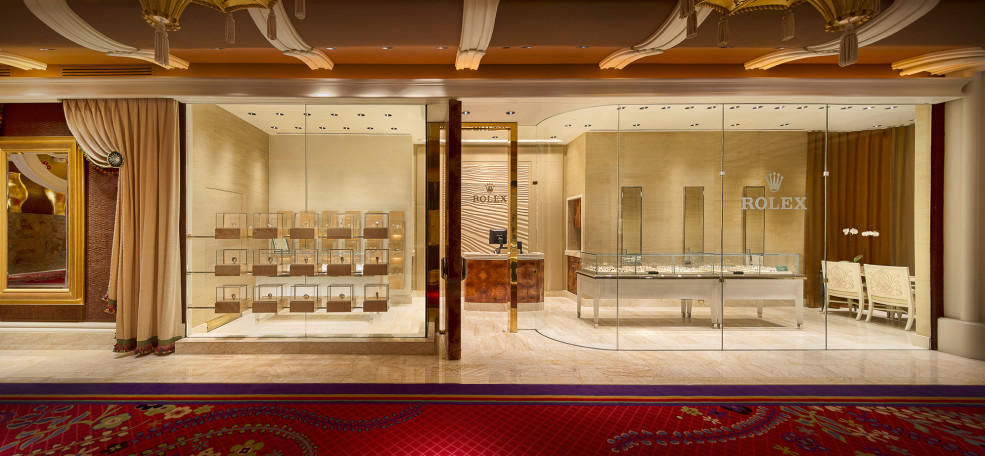
Rolex store interior photography at Wynn Las Vegas
I was hired by Wynn to photograph their new Rolex store inside the hotel. There was very limited space near the store, so the shot had to be comprised of two images and stitched together seamlessly.
Projects like this are a reminder that successful commercial photography often depends as much on problem-solving as it does on the camera itself.
Sometimes the Space Determines the Photograph
Luxury retail stores are carefully designed environments, but they aren’t always designed with photography in mind. Many boutiques maximize display space while leaving very little room for a photographer to work. When photographing high-end retail interiors, finding the right perspective often becomes one of the biggest challenges.
In situations like this, simply switching to a wider lens isn’t always the best solution. Extremely wide lenses can introduce distortion, making walls, shelving, and architectural lines appear unnatural. For luxury brands, where every design detail matters, accuracy is just as important as aesthetics.
Creating One Image From Two Photographs
For this assignment, the solution was to photograph the store in two carefully planned sections and combine them into a single final image. This technique, often used in architectural interior photography, preserves natural proportions while allowing the entire space to be shown without obvious distortion.
The process requires precision. Camera position, exposure, perspective, and lighting all need to remain consistent so the final photograph appears completely natural. When done correctly, viewers never realize they are looking at more than one image.
These techniques are common in commercial photography because every project presents different physical limitations. The goal is always to overcome those challenges while faithfully representing the architecture and interior design.
Precision Matters for Luxury Retail Photography
Luxury brands invest heavily in the design of their retail spaces. Materials, lighting, display cases, and finishes all contribute to the customer experience. Professional retail interior photography should preserve those details while accurately representing the scale and atmosphere of the space.
Photographs like these are often used across websites, advertising campaigns, editorial publications, presentations, and marketing materials. They become part of the brand’s long-term visual identity, making technical accuracy just as important as artistic composition.
Every Assignment Requires a Different Solution
One of the things I enjoy most about commercial photography is that no two projects are exactly alike. Sometimes the challenge is changing weather. Other times it’s photographing after hours or balancing difficult lighting. In this case, the challenge was simply finding a way to show the complete space when there wasn’t enough room to capture it in a single frame.
Assignments like this demonstrate that architectural photography isn’t only about documenting beautiful spaces. It’s also about understanding how to solve technical challenges while creating photographs that feel effortless to the viewer. When those solutions become invisible, the architecture and design remain the focus – exactly where they should be.